
Line Between Worlds
The Singular Vision of Jean Giraud

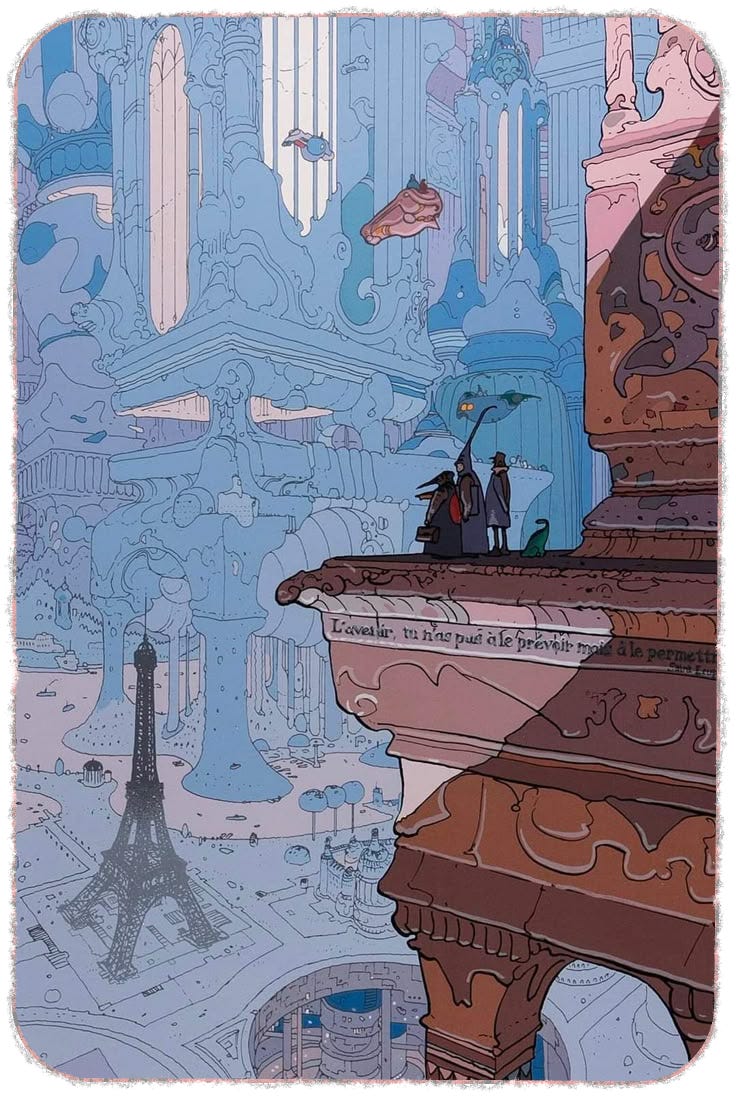
When we were running our animation company, Whatnot Entertainment, we had a mantra when things were dicey, “What would Moebius do?” Because, for us, it all ended and began with Moebius. There were many influences: the dynamic frames of Kirby, the graphic storytelling of Eisner, and the romance of Frazetta, so many more. All of those influences coalesced in Moebius.
A young Frenchman named Jean Giraud was hired to draw a Western comic strip called Blueberry for a magazine called Pilote. He was twenty-five years old, lean and restless, and he had just returned from a tour of duty in Algeria, where he had spent his idle hours sketching the desert. The desert had done something to him, clarified something. The vast, indifferent landscapes, the quality of light that seemed to flatten and amplify simultaneously, the way distance could become philosophical, all of it had lodged inside him like a splinter. When he began to draw the American frontier, the American West he had never visited, he drew the Algeria he had. The sand dunes became mesa. The light was the same merciless light. Nobody, at the time, noticed the substitution. But the substitution was everything.
Giraud would spend the next five decades producing some of the most consequential graphic art of the twentieth century, working under two names that became, in a sense, two distinct personalities. As Gir, he drew Blueberry, a gritty, psychologically complex Western that dismantled the mythology of the American frontier with the cool precision of a man who had never been seduced by it. As Moebius, he drew everything else: cosmic deserts without horizons, cities of impossible architecture, travelers who moved through space and time as if gravity were optional. Together, the two names constitute one of the great artistic bodies of work in modern Western culture. And yet in the United States, the country whose iconography he cannibalized and transfigured and sent back across the Atlantic, his name is known, if it is known at all, mostly by artists and filmmakers who cite him the way physicists cite Einstein: as the person who changed the conditions under which everything else became possible.
The story of how a child from the banlieue of Paris became the presiding aesthetic spirit of modern science fiction is, in some ways, a straightforward story about talent and timing. Giraud was born in 1938 in Nogent-sur-Marne, just east of Paris, and his childhood was organized around the compensatory pleasures available to a working-class boy in postwar France: movies, mostly, and comic books. His parents separated when he was young, and he was raised largely by his grandparents in the Corrèze, a rugged inland department in central France whose landscape, remote, elemental, a little severe, would surface again and again in his drawings decades later. He showed a talent for drawing almost before he showed a talent for anything else, and by his mid-teens he was already submitting work to professional magazines.
What distinguished his early draftsmanship from that of his peers was not, by most accounts, any single quality but rather the peculiar combination of qualities that would define his mature work: a line of extraordinary control and expressiveness, a compositional instinct that treated empty space as actively as filled space, and an almost pathological commitment to accuracy of detail that existed in productive tension with a willingness to invent freely. He was, in other words, a realist who did not believe in realism, or who believed in it only as a departure point, a set of rules precise enough that their violation would register as violation, and therefore as meaning.
The artistic world Giraud entered in the early 1960s was a peculiarly fertile one. French comics, bande dessinée, or BD, occupied a cultural position that had no real equivalent in the Anglo-American world. In France and Belgium, comics were not a low medium redeemed by occasional seriousness; they were a legitimate art form with a serious readership, ambitious practitioners, and the kind of cultural prestige that in England or America was reserved for novels or film. Tintin had appeared on the covers of Belgian magazines. Asterix was a national phenomenon. The magazine Pilote, where Giraud would spend his formative years, was edited by René Goscinny, the co-creator of Asterix, who had a gift for identifying and cultivating talent that bordered on the oracular.
Within this world, the Western was a genre of unusual importance. The French relationship to the mythology of the American frontier has always been complicated, simultaneously fascinated and skeptical, hungry for the romance while alert to the violence and dispossession concealed within it. French intellectuals had been arguing about the Western since at least the 1950s, when Bazin and the critics of Cahiers du Cinéma began to treat John Ford and Howard Hawks as artists worthy of serious attention. For Giraud, who had grown up on American Westerns at the local cinema and had returned from Algeria with a new understanding of what deserts actually felt like, the genre was an invitation to do something complicated. Blueberry, the series he developed with writer Jean-Michel Charlier, was nominally a classic Western, full of cavalry and gunslingers and wide horizons, but its hero was morally ambiguous in ways that American Westerns of the era rarely permitted, and its world was drawn with a gritty, documentary specificity that made the mythological machinery of the genre visible rather than invisible.
The question of when Jean Giraud became Moebius is one that resists a clean answer. The name itself, taken from the Möbius strip, the mathematical object with only one surface, the loop that folds back into itself, appeared for the first time in the late 1960s, when Giraud began publishing experimental short stories in Pilote that bore no relationship, stylistically or thematically, to anything he had drawn before. The stories were strange in a way that “strange” barely describes. They depicted desert planets with no apparent inhabitants, traversed by lone figures whose purpose and destination were never specified. The images had a quality of silence, not the dramatic silence of a Western standoff, but the silence of deep space, or deep time, or both. The line was different, too: cleaner, more absolute, stripped of the cross-hatching and textural richness of Blueberry, as if Giraud had decided that the new territory he was entering required a new instrument.
The clean line, the ligne claire in French, was not, strictly speaking, Moebius’s invention. It was associated primarily with Hergé, the creator of Tintin, whose style was characterized by outlines of uniform weight, flat colors, and a studied absence of shadow. But what Moebius did with the clean line was entirely his own. Where Hergé used clarity in the service of legibility the world of Tintin is always exactly as it appears, Moebius used clarity in the service of mystery. His images were precise and unambiguous in their surfaces and utterly opaque in their depths. You could see everything; you understood nothing. The effect was not frustrating but hypnotic. He had found a way to use the conventions of realism to produce something that felt, and functioned, as the pure opposite of the real.
By the time the magazine Métal Hurlant was founded in 1975, Moebius had been building toward something for nearly a decade. Métal Hurlant, which appeared in the United States as Heavy Metal, was conceived by Giraud and a small group of French artists as a venue for adult science fiction and fantasy comics, free from the editorial constraints of family publications, free to be violent or sexual or surreal or all three simultaneously. The timing was fortunate, or perhaps the timing was inevitable. The mid-1970s were a moment of unusual cultural porousness, when the barriers between high art and popular culture were eroding in multiple fields simultaneously, and when science fiction, long ghettoized as genre entertainment, was beginning to be taken seriously as a form capable of philosophical ambition. Métal Hurlant gave Moebius a platform, and the platform gave him permission.
What followed was an explosion of work so diverse and so consistently extraordinary that it has never quite been processed in its totality. The Airtight Garage of Jerry Cornelius, later simply The Airtight Garage, was an ongoing serial that Moebius drew without a script, improvising panel by panel, making up the story as he went in a way that produced something less like a conventional narrative and more like a record of a mind in the act of dreaming. Arzach, published in 1975, was entirely wordless: a traveler on an enormous pterodactyl-like creature moving through landscapes of surpassing strangeness, with no explanation, no context, no resolution. It was not, strictly speaking, a story. It was something more like a sustained experience of a particular quality of attention, alert, unhurried, willing to let the image simply be without demanding that it mean.
The impact on the generation of artists who encountered this work in their formative years is almost impossible to overstate. The list of filmmakers, illustrators, game designers, and writers who have cited Moebius as a fundamental influence reads like a catalog of the last fifty years of visual culture. Ridley Scott’s Blade Runner, which established the aesthetic vocabulary of cyberpunk cinema, owes a debt to Moebius that Scott himself has acknowledged. The Fifth Element, Luc Besson’s operatic 1997 science fiction film, was designed in explicit collaboration with Moebius and his colleague Jean-Claude Mézières. The alien environments of James Cameron’s Avatar, the floating mountains, the bioluminescent forests, the sense of a world whose physical laws differ fractionally from our own, are unimaginable without Moebius’s prior invention of that particular visual vocabulary. And then there is Star Wars, the most commercially successful franchise in the history of cinema, whose art director Ralph McQuarrie worked directly from Moebius’s pages, a fact that is acknowledged in occasional artist retrospectives and then promptly forgotten by the culture at large.
There is something worth pausing over in this pattern of acknowledgment and forgetting. Moebius occupies a peculiar position in the cultural history of the late twentieth century: he is simultaneously indispensable and obscure, a secret presence inside some of the most visible artifacts of popular culture, known intimately by the artists who built those artifacts and almost not at all by the audiences who consumed them. In the United States especially, where his work was never distributed with the same reach that it had in France, his name functions as a kind of shibboleth, a way of recognizing, among people who care about visual storytelling, a shared understanding of what is possible.
This invisibility is partly a matter of medium and partly a matter of geography. Comics, even now, carry less cultural prestige in the United States than they do in France, and the critical apparatus for evaluating them is correspondingly less developed. But there is something else, too, something harder to name. Moebius’s work operates at a frequency that resists easy description, not because it is obscure in the pejorative sense, but because it addresses itself to something prior to language, something that exists in the eye and the nervous system before it reaches the part of the brain that makes sentences. To write about it is already to falsify it. The images work by accumulation and atmosphere and a kind of visual logic that has no precise verbal equivalent, and the critical vocabulary for that kind of experience is, even now, relatively impoverished.
In 1974, Moebius met Alejandro Jodorowsky, the Chilean filmmaker and provocateur, and began work on what would become one of the most celebrated unmade films in history. Jodorowsky had acquired the rights to Frank Herbert’s Dune and conceived a production so extravagant and so radical, with a cast that would include Salvador Dalí, Orson Welles, Mick Jagger, and a score by Pink Floyd, that it seems, in retrospect, less like a film than like a declaration of aesthetic war against the entire concept of commercial cinema. Moebius was hired to produce storyboards, and what he produced, thousands of drawings, each one a finished work in its own right, constituted a visual bible for a universe that never came to exist on screen. The project collapsed when funding evaporated, but the storyboards were distributed widely in the film industry, and their influence on Alien, Flash Gordon, and eventually Star Wars was immediate and measurable. The unmade film became, paradoxically, one of the most influential films ever not made.
The Dune project illuminates something essential about Moebius’s position in the culture: he was perpetually the source and rarely the destination. His work flowed outward into other forms, other media, other artists’ visions, with a generosity that was partly temperamental and partly the result of the specific status of comics in the cultural hierarchy. Film directors, game designers, and novelists absorbed his vocabulary and redistributed it to audiences who had never heard his name. He was credited, when he was credited at all, the way architects credit the engineers whose calculations made their buildings possible, as a technical necessity rather than an imaginative origin.
The late work is, in many ways, the strangest and most beautiful. After decades of productivity that would have been remarkable even without its extraordinary quality, Moebius continued in his final years to produce images of an almost disturbing serenity, figures moving through vast landscapes with the unhurried confidence of people who have stopped expecting to arrive anywhere. There is something in these images that suggests a sustained meditation on scale: the scale of the universe relative to human consciousness, the scale of a lifetime relative to the images that flicker through it. The figures are always small. The landscapes are always enormous. The sky, when there is a sky, is always doing something the sky does not actually do.
Jean Giraud died in March 2012, in Paris, at the age of seventy-three. The obituaries were respectful and, in the American press, rather brief. They noted his influence on science fiction cinema, cited the usual list of directors and designers who had acknowledged their debts, and moved on. What they could not quite capture, what the genre of the obituary is structurally ill-suited to capture, was the quality of the experience of actually looking at his work: the stillness it produces, the sensation of having entered a space where the ordinary transactions of time and meaning have been suspended, the peculiar combination of absolute technical mastery and absolute imaginative freedom that makes his best pages feel less like drawings and more like windows. Windows into what, exactly, is a question the work declines to answer. That refusal is not a failure of vision but its highest expression.
Somewhere, right now, in some art school studio or animators’ workshop or novelist’s back room, a person who has never heard of Jean Giraud is producing work that would be unrecognizable without him. The line continues, clean and infinite, folding back into itself.
Jean Giraud / Moebius (1938–2012) produced work across more than fifty years, including the Blueberry series, the Lieutenant Blueberry run, The Airtight Garage, Arzach, The Incal (with Alejandro Jodorowsky), Silver Surfer: Parable (with Stan Lee), and numerous short story collections. His storyboards for the unmade Jodorowsky Dune were documented in the 2013 film Jodorowsky’s Dune.